

From 0 to 1 Building An Educational App to Help Surgery Patients Manage Pain Safely and Prevent Opioid Misuse
CLIENT
Behavioral Health Wellness Group (BHWG)
DURATION
Sep - Dec 2023
TEAM
Roey Wang (Product Designer): Competitive analysis, user interviews, persona, information architecture, style guide, key workflows, wireframes & prototype (Homepage, MyProfile, Pre-Surgical, Medication Reminder).
Nishi Chitale (Project Manager), Sayali Nikumbh (UX Researcher), and Xinru Wen (UI/UX Designer)
Meet Andrew - Our Primary User

For the past five years, arthritis has gradually made everyday activities more difficult. After multiple rounds of physical therapy, his doctor recommends knee replacement surgery.
The surgery promises long-term relief—but Andrew is anxious about the recovery.
He wonders:
-
How painful will recovery be?
-
How long will it take to get back to normal?
-
What exactly are opioids, and are they dangerous?

At his pre-operation appointment, Andrew receives a thick booklet explaining opioid safety.
He skims a few pages before putting it aside.
The information feels overwhelming, and the recovery journey ahead feels uncertain.
Andrew’s situation reflects a broader problem faced by many surgery patients.
Problem
Patients undergoing major surgery often rely on opioids for pain management, but many lack clear, accessible guidance on how to use them safely.

Information Overload

Limited understanding of opioid risks

Lack of ongoing support during recovery

Complex recovery experiences
To understand the needs of patients like Andrew, we conducted multiple research activities.
Literature Review
We explored medical research and healthcare guidelines related to opioid usage.
Key insights included:
-
Opioids are effective pain relievers but carry a risk of dependency when misused.
-
Patient education plays a critical role in preventing opioid misuse.
-
Medication tracking and reminders can help patients maintain safe dosage patterns.
Ecosystem Mapping
We mapped the recovery ecosystem to understand the stakeholders influencing patient behavior.
Key stakeholders included:
-
orthopedic surgeons
-
nurses
-
physical therapists
-
caregivers
-
behavioral health experts
This helped us identify an important gap:
Patients receive expert guidance before surgery, but lack structured support during recovery at home.

User Interviews
Key Insights
Accessibility is essential
Most knee and hip replacement patients are 45 years or older, making clear navigation and readability critical.
Patients trust doctors but forget instructions
Once home, many patients struggle to recall medication guidelines.
Recovery is emotionally challenging
Patients often feel uncertain about whether their recovery progress is normal.
Patients want multiple recovery strategies
Medication is helpful, but patients are also interested in alternative ways to manage pain.
Defining the Design Strategy
Our research informed four guiding design principles.
1. Simplify Complex Medical Information
Educational content must be clear, digestible, and actionable.
2. Reduce Anxiety During Recovery
The interface should feel supportive, calm, and trustworthy.
3. Design for Accessibility
The app must be easy to navigate for older users.
4. Empower Patients
Users should feel confident managing their recovery rather than overwhelmed by it.
Opportunity
The Behavioral Health Wellness Group previously offered an in-person opioid prevention course to help educate surgery patients.
However, the course stopped during COVID-19.
This created an opportunity to reimagine the program in a digital format that patients could access anytime during recovery.

Transform educational content into an engaging digital experience

Support safe medication behavior during recovery

Make medical information accessible for patients aged 45+

Provide emotional reassurance during the recovery process
Solution: HealSmart
HealSmart is a mobile platform that supports surgery patients throughout their recovery journey.
It provides:
-
opioid education
-
medication tracking tools
-
alternative pain management resources
-
structured recovery guidance
Instead of overwhelming patients with information, HealSmart delivers support exactly when patients need it.
How Andrew Will Navigate HealSmart
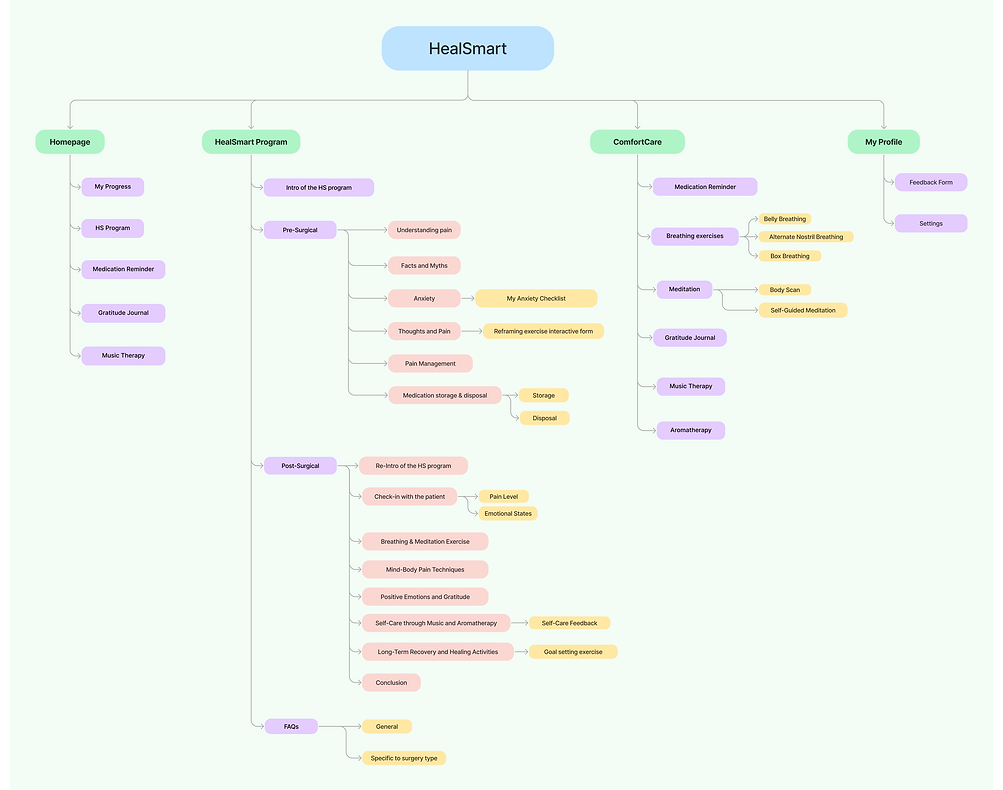
Information Architecture
The IA is structured so Andrew can quickly find:
-
Home — his recovery hub
-
MOP Program — step-by-step opioid education
-
PainEase Kit — non-drug pain management tools
-
My Profile — medication tracking & reminders
-
Every screen guides Andrew without overwhelming him.
Visual Design
Fonts
-
Merriweather for titles → conveys trust, professionalism, authority
-
Lato for content → clean, readable, friendly
Colors
-
A calming, trustworthy green theme, reducing stress and signalling healing
-
Consistent branding to help Andrew recognize reliability across the app

Product Architecture
To support Andrew’s recovery journey, we structured the application into four core sections.

HealSmart
A digital version of the Medication Opioid Prevention course, redesigned into easy-to-follow learning modules.
Instead of reading long documents, patients learn through short, structured content.
Home Dashboard
The central hub where patients can quickly access:
-
medication reminders
-
recovery progress
-
key educational resources

Medication Reminder
The central hub where patients can quickly access:
-
medication reminders
-
recovery progress
-
key educational resources
Conclusion
